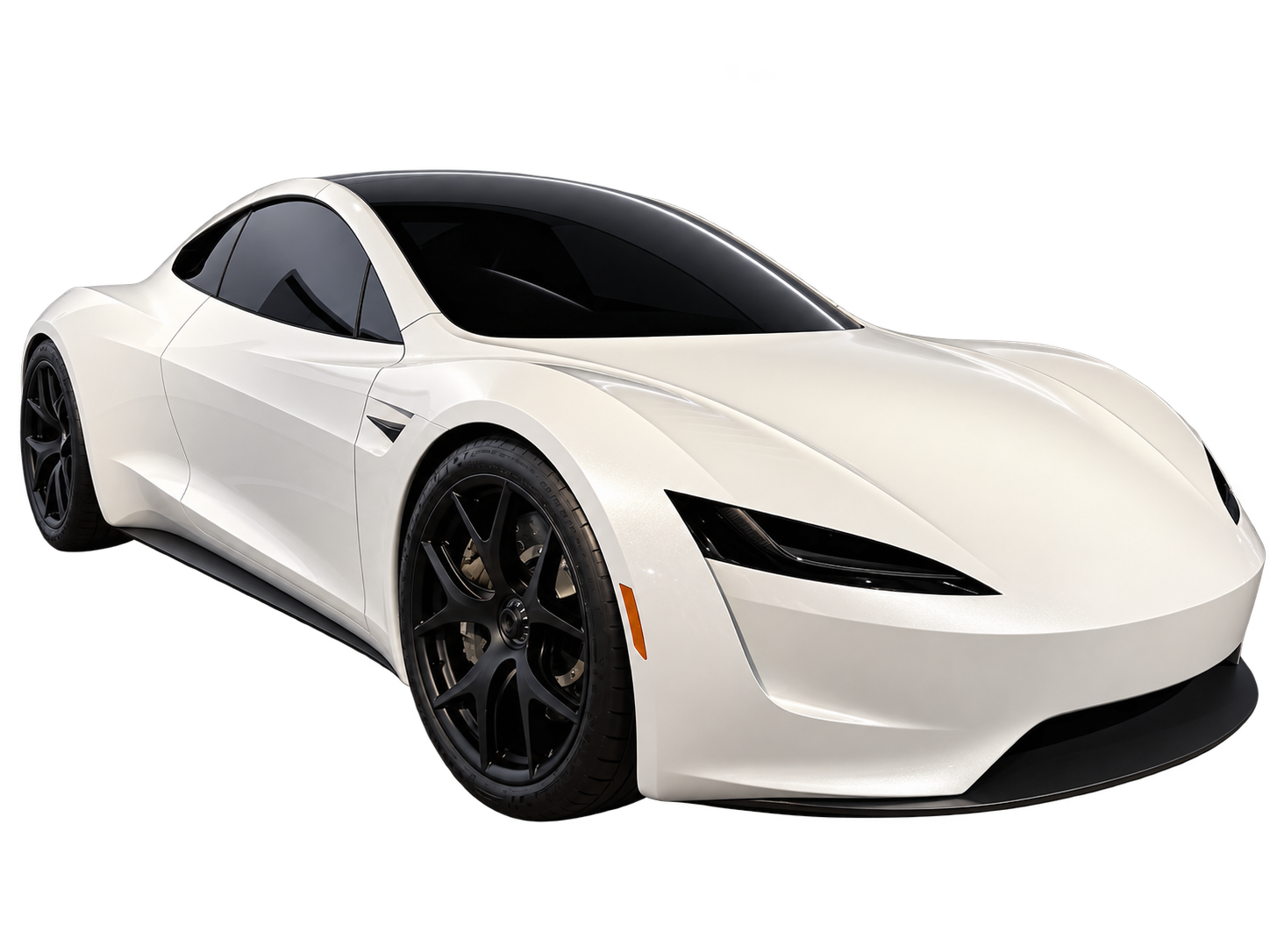
The answer depends on the version and the use being discussed. Tesla's Rocket description currently carries a restriction against public-road use. That is a narrower and more useful statement than declaring every Roadster illegal, or claiming the flying version will eventually be approved.
Read the restriction next to the configuration
The official page distinguishes Performance, Thrust and Rocket. It presents Performance as road-oriented, while Rocket carries the public-road restriction. Check the descriptions and footnotes together, rather than moving a claim from one version onto another. Read Tesla's current Roadster page.
Descriptive product language is not the same as a registration record for a particular vehicle in a particular market. A reservation page can explain the intended positioning of a version without proving that a customer can take delivery and register one today.
When reading an article, ask whether its subject is a demonstrated configuration, a proposed customer specification or an already delivered vehicle. If the writer changes between those subjects without saying so, even a technically correct sentence can lead to the wrong conclusion.
Separate three questions hidden inside “street legal”
- Which vehicle? Identify the exact version and equipment, not just the Roadster name.
- Which activity? Driving normally on a road, using a performance feature on a closed course and leaving the ground are different activities.
- Which place and date? A statement about one region or a future plan does not establish the current position elsewhere.
The UK product page expressly qualifies availability by regional requirements. This article does not establish approval in any particular jurisdiction; verify the applicable status with the relevant authority and current vehicle documentation before relying on it.
Do not replace those details with a broad prediction. “Could regulations change?” is a different question from “what is permitted now?” No date on a launch slide answers the first, and a spectacular demonstration does not answer the second.
A demonstration is evidence of the demonstration
A prepared event can show a movement under the conditions used there. It does not establish permission to perform that movement in traffic. The absence of a visible restriction sign in a clip is not evidence of approval either.
Look at the claim attached to the clip. “The vehicle performed this manoeuvre during a demonstration” is different from “customers can do this on their commute.” The latter introduces assumptions about delivery, equipment and permitted use that the picture cannot supply.
News headlines often omit these distinctions because space is short. Read the source material before turning a headline into a caption. If the version is not identified, retain the uncertainty rather than filling it with a confident yes or no.
Will the restriction change?
There is no sound basis here to promise future approval. A product could change, availability could differ between regions, and a feature could remain restricted. Each outcome would require current evidence. This page records the material checked on October 19, 2026; it is not a forecast of an approval process.
For updates, look for a dated manufacturer statement identifying the version and market, followed by the relevant documentation. Keep older statements labelled by date. A newer-looking video with an old caption is not a policy update.
How to label a fictional Roadster video
If you generate a car rising over a busy road, identify it as an imagined AI scene. Do not present the sequence as proof of a street-legal feature, a customer test drive or a recording of the actual vehicle.
You can still make the premise entertaining. Describe what happens in your fictional story and avoid attaching unsupported availability claims to it. On Flying Car AI, a text description and one optional reference image create a silent vertical MP4; the output is entertainment, not vehicle documentation.
Continue with how the different forces work, or use the verification guide to assess a particular clip. Without the original upload, the right conclusion about a specific video may simply be “unverified.”
This is a reading of manufacturer material and basic physical principles, not a vehicle test, certification assessment or prediction of regulatory approval. Flying Car AI is independent and not affiliated with, endorsed by or sponsored by Tesla, Inc. The videos generated on this site are fictional.