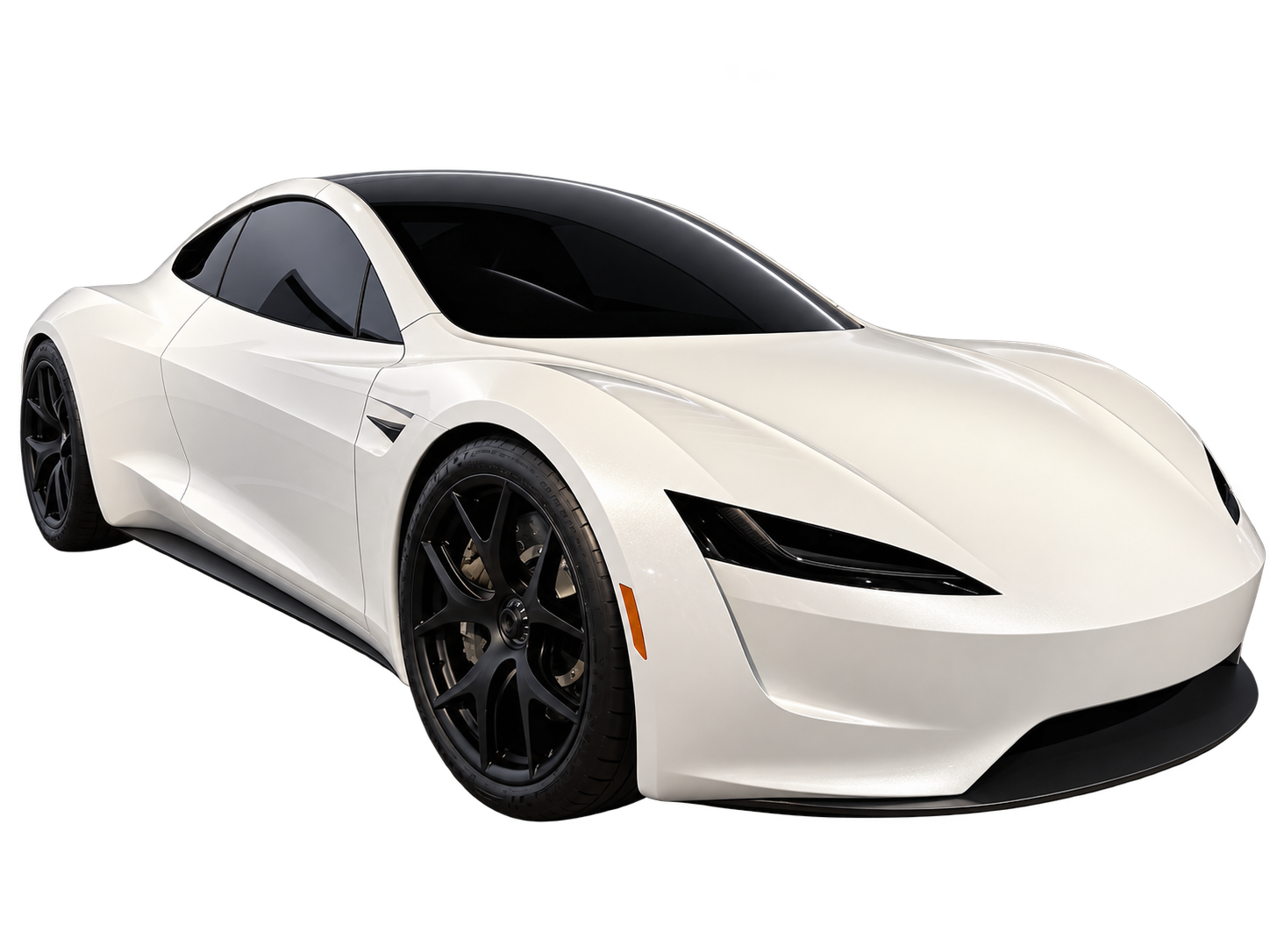
An AI video can have convincing reflections and still show the wrong Roadster. The most common planning mistake is to use “Tesla Roadster” as though it described one fixed body shape. Before choosing a reference, decide whether your subject is the 2017 concept, the redesign revealed in October 2026 or your own fictional interpretation.
This is a reference-selection problem before it is a prompt-writing problem. If the starting image and the written brief describe different cars, adding detail can make the disagreement worse. Choose one visual identity and keep it through the whole shot.
Separate the silhouette from the badge
MotorTrend's direct design walkthrough describes a move from the 2017 concept's rounded bodywork to a more angular wedge, and reports removable glass roof panels arranged around a central roof section. Those are useful identification cues because they change the outline of the car. See the design walkthrough.
A badge is a weak starting point for reviewing a generated vehicle. It can remain in place while the roof, wheelbase or door opening changes. Silhouette is harder to fake consistently: the height of the windscreen, the relationship between the cabin and rear deck, and the shape around the wheels all have to agree.
Road & Track's launch report also highlights the shift toward angular styling. That corroborates the broad visual change; it does not mean every fan render with sharp bodywork represents the actual vehicle. Compare your reference with a dated source rather than trusting its filename or search-result caption. Read Road & Track's reveal report.
Build a small reference record
For each image you are considering, record its source, date, rights status and the car it claims to show. “Roadster photo” is not enough. “Manufacturer image of the October 2026 reveal car, front three-quarter angle” tells you what the reference can explain and what it cannot.
Use an image you own or are permitted to use. Public access to a press photograph does not give you automatic permission to upload it to a generation service. Links in this article identify research sources; they are not a licence to reuse those publications' photographs.
Then choose the view that matches the intended shot. If the finished scene is about a side-on lift, a clean profile is more useful than a dramatic close-up of a headlamp. If the car is to remain on the road, you may not need a view of the underside at all. Do not ask a single image to establish details it never shows.
Choose three features that must remain stable
Write a short review list outside the generation prompt. For a rear three-quarter shot, you might choose the roof outline, rear-light shape and wheel spacing. For a front view, choose the windscreen proportions, nose shape and position of the visible lights. These are acceptance criteria, not a catalogue of every panel.
The list helps separate two kinds of failure. A slightly different reflection is usually a lighting variation. A roof that changes shape as the car turns is an identity failure. Fixing the second problem by asking for more cinematic lighting is unlikely to address the cause.
At the site's 480p output resolution, judge the car at normal viewing size as well as paused. Tiny badges are a poor primary test. Broad geometry, consistent colour and stable wheels remain meaningful when the video is viewed on a phone. Cropping a distant car until it fills the screen magnifies defects; it does not recover detail that was never rendered.
A ten-second design study needs less camera movement than you think
Consider a ten-second shot with a clear side view, a modest movement across frame and a settled final position. The opening establishes the outline. The middle tests whether that outline survives movement. The final moment lets the viewer compare it with what they first saw. This is a planning example, not a tested recipe or a guarantee of model behaviour.
A full orbit makes a different demand: it asks the system to invent every hidden surface while changing reflections and perspective. That may suit a loose concept film. It is a poor first choice when the editorial point is a subtle difference between two designs.
If an orbit produces mixed-era bodywork, reduce the change of viewpoint before increasing the length of the description. Keep the camera near the reference angle and make one useful movement. You can build a longer comparison from separately reviewed shots rather than expecting one continuous clip to solve every view.
Do not animate an engineering claim by accident
An opening panel, moving wing or unusual roof motion is a statement about how a vehicle works when shown in an explainer. Use a source that actually establishes the movement, not merely a photograph of the part in its final position. Otherwise present the animation as an imagined treatment.
The same applies to interior transitions. Cutting from a known exterior to an invented cockpit can quietly switch from reporting to fiction. A short exterior-only sequence may communicate the design comparison more honestly than a seamless tour that invents the missing information.
Our reference-image guide explains the broader trade-offs between text and one optional image. Text-only remains a valid choice when you want a fictional sports car rather than a faithful recreation of a particular Roadster.
Label the comparison so it stays understandable after a repost
Use dates and a description of the source vehicle in the comparison itself. Label an AI interpretation separately. Avoid a heading that calls an invented render an official redesign, and do not imply your generated clip is a photographic record of the reveal.
Before export, pause at the first clear view, the largest change of angle and the final frame. If the car no longer belongs to the same design at all three points, shorten or replace the shot. A concise comparison with stable geometry is more informative than a longer film that blends two generations into a vehicle that never existed.
Reporting method: this article draws on the linked manufacturer material and published automotive reporting. We did not attend the reveal, drive the car or independently measure its performance. The filming and AI scene-planning analysis is our editorial interpretation. Flying Car AI is independent and is not affiliated with, endorsed by or sponsored by Tesla, Inc.